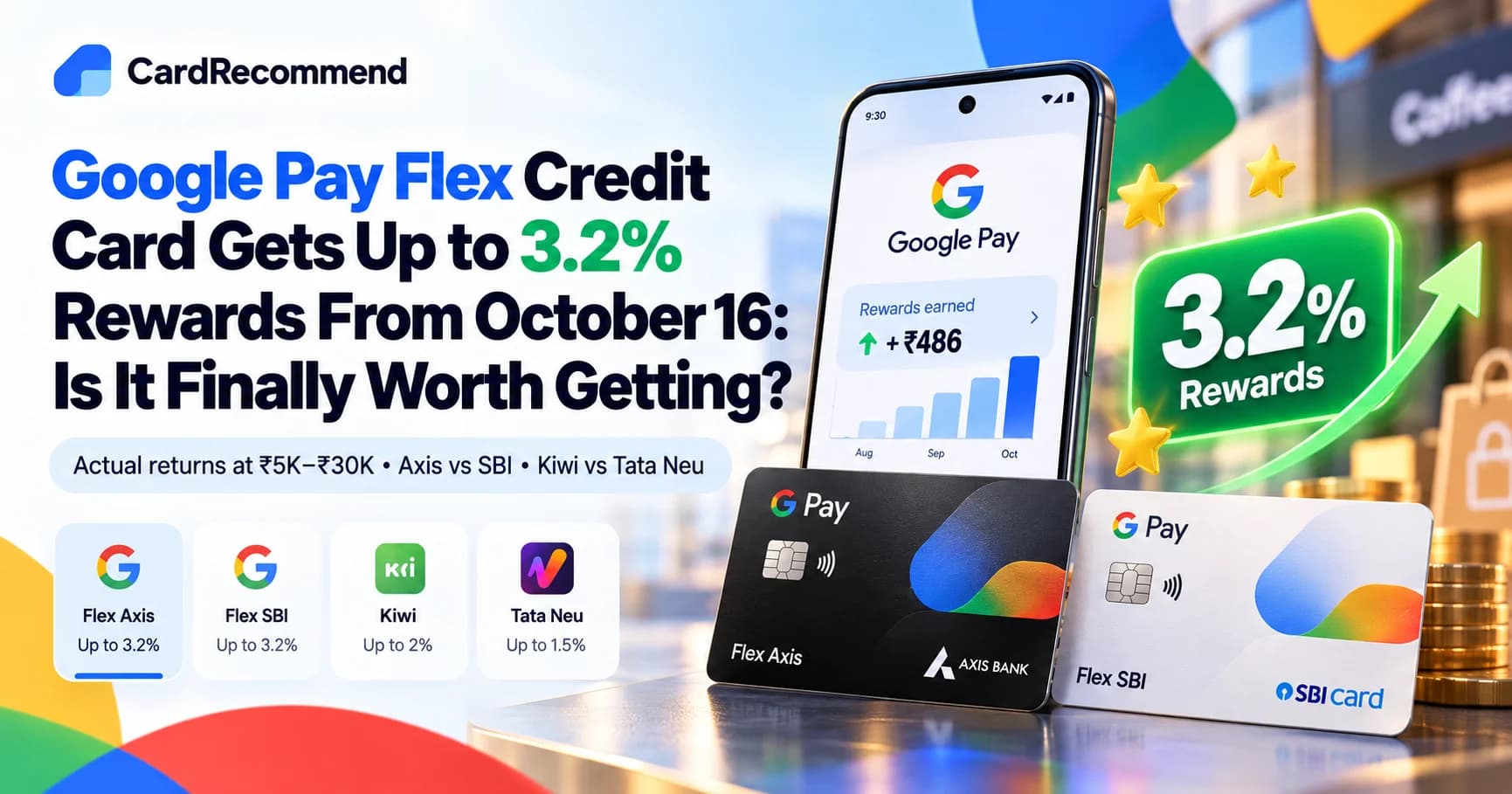
Editorial Disclosure:This analysis is based on official Google Pay, Axis Bank, and SBI Card programme disclosures effective October 16, 2026. Card reward structures, fee waivers, merchant inclusions, and milestone terms are subject to institution policy.MoreLess
Google is completely reworking the Flex rewards programme from October 16, 2026. Google One members can earn up to 3.2% back in Stars, with food, utility, and recharge bonuses. Here is the complete math at ₹5,000–₹30,000 monthly spend compared against Kiwi, Tata Neu Infinity, and Pixel Play.
Effective from: October 16, 2026 Updated: October 14, 2026
For most of its short life, Google Pay Flex had one slightly awkward problem:
It was a credit card built around Google Pay, but the rewards weren't particularly compelling for someone who already had a good RuPay UPI credit card.
That changes from October 16, 2026.
Google is completely reworking the Flex rewards programme. Eligible Google One members will be able to earn as much as 3.2% back in Google Stars on regular eligible spending, while non-Google-One users can earn up to 1.6%.
Google One members also get separate bonuses on food, groceries, utility bills, OTT and recharges.
On the surface, this suddenly makes Flex look very competitive.
But the headline “3.2% rewards” leaves out a lot.
You need to cross ₹15,000 in a reward cycle to unlock the higher rate. There is a ₹1,500 total reward cap. Some categories don't count at all. Google One eligibility has its own conditions. And the Axis and SBI versions of Flex have different fees and welcome benefits.
So the real question isn't:
“Does Flex give 3.2%?”
It is:
“At the amount I actually spend every month, how much will I really get back?”
Let's calculate it.
First: The New Google Pay Flex Rewards From October 16
From October 16, the basic reward structure becomes:
| Reward-cycle spend | Google One member | Non-Google-One user |
|---|---|---|
| Below ₹15,000 | 1.6% | 0.8% |
| After crossing ₹15,000 | 3.2% | 1.6% |
The important part is that the higher rate is retroactive to all eligible spending in that reward cycle.
Suppose a Google One member spends ₹20,000.
The first ₹15,000 does not remain at 1.6%.
Once the qualifying threshold is crossed, the full eligible ₹20,000 gets the 3.2% rate.
That creates a fairly sharp reward cliff around ₹15,000.
There is one more condition.
If you spent less than ₹100 in the previous reward cycle, these rates are halved.
For an inactive Google One user, that means 0.8% below the threshold and 1.6% above it.
For an inactive non-Google-One user, it becomes just 0.4% and 0.8%.
So Flex is clearly designed to reward people who keep using the card rather than pulling it out once every few months.
How Much Do You Actually Earn?
Let's ignore the special food and utility bonuses for a moment and calculate only the standard Flex reward.
One Google Star is worth ₹1 inside Google Pay.
Actual Reward Value
| Spend in one reward cycle | Google One | Effective return | Non-Google One | Effective return |
|---|---|---|---|---|
| ₹5,000 | ₹80 | 1.60% | ₹40 | 0.80% |
| ₹15,000* | ₹240 | 1.60% | ₹120 | 0.80% |
| ₹20,000 | ₹640 | 3.20% | ₹320 | 1.60% |
| ₹30,000 | ₹960 | 3.20% | ₹480 | 1.60% |
\There is a small but important wording issue at exactly ₹15,000. Google's current terms say the higher rate applies once you “cross ₹15,000”*. I have therefore conservatively treated exactly ₹15,000 as the lower tier. If Google operationally treats ₹15,000 itself as qualifying, that row would move to the higher rate. At ₹15,001, the published wording clearly points towards the higher tier.
And this creates a strange situation.
For a Google One member:
₹15,000 spend → roughly ₹240 under the literal wording
but:
₹15,001 spend → roughly ₹480
because crossing the threshold potentially doubles the reward rate on the whole cycle.
That makes tracking the reward-cycle spend unusually important.
Google One Users Can Actually Earn Much More Than 3.2%
Here's where the new Flex programme gets genuinely interesting.
Google One members get two additional reward milestones.
Bills, OTT and Recharges
Spend at least ₹3,000 in eligible utility, recharge, broadband, DTH, NCMC transit and OTT categories and get:
₹450 in additional Stars
Food and Grocery
Spend at least ₹5,000 through UPI at eligible merchants such as Swiggy, Zomato, Blinkit, Zepto, BigBasket and other listed partners and get:
₹250 in additional Stars
Both can be earned in the same reward cycle.
So a Google One member can potentially add another:
₹700 in Stars
on top of the regular reward rate.
This changes the maths quite dramatically.
Maximum Practical Return for a Google One User
Assume your spending mix allows you to hit the relevant category milestones.
| Total spend | Base Stars | Possible category bonus | Total reward | Effective return |
|---|---|---|---|---|
| ₹5,000 | ₹80 | ₹450 | ₹530 | 10.60% |
| ₹15,000* | ₹240 | ₹700 | ₹940 | 6.27% |
| ₹20,000 | ₹640 | ₹700 | ₹1,340 | 6.70% |
| ₹30,000 | ₹960 | ₹700 | ₹1,500 capped | 5.00% |
This table needs context.
Flex has not suddenly become a flat 10% cashback card.
The ₹530 return at ₹5,000 works only if at least ₹3,000 falls into the eligible utility/recharge/OTT bucket and earns the ₹450 milestone.
Similarly, to get both bonuses you need the right combination of food/grocery and utility-related expenditure.
Still, this is the part of the update that I find much more interesting than Google's 3.2% headline.
At ₹20,000 of intelligently structured spend, a Google One member could theoretically earn around ₹1,340, giving a blended return of roughly 6.7%.
That is genuinely strong.
Then the ₹1,500 Cap Starts Hurting
All Flex rewards are capped at:
1,500 Stars per reward cycle
And for Google One users, that includes the category bonuses.
This matters.
At ₹30,000, the regular 3.2% reward gives ₹960.
Add ₹700 of category bonuses and you would mathematically reach ₹1,660.
But Google caps it at:
₹1,500
So your actual return drops to 5%.
As spending climbs further, the effective percentage keeps falling because the reward stops increasing once the cap has been reached.
Flex therefore has a sweet spot.
It's not really designed to be a ₹1 lakh-per-month rewards card.
For someone spending roughly ₹15,000–₹30,000 per reward cycle, especially with Google One and the right spending mix, it becomes much more interesting.
Google Pay Flex vs Kiwi: This Is the Comparison That Matters
If your priority is UPI rewards, Kiwi is probably the most obvious competitor.
A standard Kiwi-issued RuPay card currently gives:
1.5% cashback on eligible Scan & Pay UPI transactions
and:
0.5% on eligible online transactions
with no Google One membership and no ₹15,000 threshold.
Kiwi cards are also lifetime free.
And Kiwi has another advantage:
The reward is much closer to actual cashback. It can be moved to the linked bank account instead of being trapped inside a reward ecosystem.
Flex Stars have a fixed ₹1 value, but you redeem them against Flex payments or vouchers inside Google Pay. You cannot simply cash them out to your bank account.
That difference matters.
At ₹5,000 Monthly UPI Spend
Kiwi at 1.5%:
₹75
Flex without Google One:
₹40
Flex with Google One:
₹80
At low spend, Kiwi is clearly better than Flex for a non-Google-One customer.
A Google One user barely beats Kiwi on the standard reward rate — before considering Flex's category bonuses.
At ₹20,000
Kiwi:
₹300
Flex non-Google-One:
₹320
Flex Google One:
₹640
Now the picture changes completely.
After crossing ₹15,000, even the non-Google-One Flex rate slightly overtakes standard Kiwi Scan & Pay.
For an eligible Google One member, Flex is in a different league at this spend level.
What About Kiwi Neon?
Kiwi Neon increases Scan & Pay cashback to 2%, with higher milestone rewards as annual eligible spending rises.
But Neon costs money and has its own milestone structure.
That makes the choice more nuanced.
If you want simple cashback from low monthly UPI spending, Kiwi remains extremely easy to understand.
If you already pay for Google One and consistently spend above ₹15,000, Flex suddenly becomes much harder to ignore.
Flex vs Tata Neu Infinity
Tata Neu Infinity is another popular RuPay UPI option.
On eligible UPI transactions, the HDFC Bank version earns:
0.5% NeuCoins normally
plus another:
1% when the transaction is made through the Tata Neu UPI ID
giving a maximum normal UPI return of:
1.5%
There is a monthly cap of 500 NeuCoins on UPI rewards.
So at the spending levels we're comparing:
| Spend | Tata Neu Infinity at 1.5% |
|---|---|
| ₹5,000 | ₹75 |
| ₹15,000 | ₹225 |
| ₹20,000 | ₹300 |
| ₹30,000 | ₹450 |
NeuCoins are worth ₹1 each, but they are most useful inside the Tata Neu ecosystem.
And unlike the lifetime-free Axis Flex, the regular Tata Neu Infinity card carries a meaningful annual fee unless you have received it under an LTF or other special offer.
If your primary goal is simply UPI rewards, the new Flex structure is much more competitive than it was before.
What About HDFC Pixel Play?
The RuPay version of HDFC Pixel Play gives:
1% cashback on eligible UPI spends
with a monthly cap of 500 CashPoints.
That gives:
- ₹50 on ₹5,000
- ₹150 on ₹15,000
- ₹200 on ₹20,000
- ₹300 on ₹30,000
It's simple.
But for anyone consistently crossing the new Flex threshold, Flex now has significantly more upside.
Scapia Is Still Interesting — But for a Different Reason
Scapia's RuPay card gives 5% back in Scapia Coins on eligible UPI transactions of ₹500 or more.
But five Scapia Coins are worth ₹1.
So the effective value is:
1%
And the Coins are primarily useful for travel booked through Scapia.
That means ₹20,000 of eligible UPI spending would generate approximately ₹200 of travel value.
Flex Google One at the same ₹20,000 gives ₹640 in base Stars before category bonuses.
Scapia still has its own reasons to exist — zero forex, travel rewards and airport benefits are major parts of that product.
But purely as a UPI rewards comparison, Flex becomes much more competitive from October 16.
The UPI Comparison in One Table
Assuming eligible spend and ignoring special promotional/milestone bonuses:
| Card | ₹5k spend | ₹15k spend | ₹20k spend | ₹30k spend | Apply |
|---|---|---|---|---|---|
| Flex – Google One | ₹80 | ₹240* | ₹640 | ₹960 | Compare |
| Flex – Non-Google One | ₹40 | ₹120* | ₹320 | ₹480 | Compare |
| Kiwi standard Scan & Pay | ₹75 | ₹225 | ₹300 | ₹450 | Compare |
| Tata Neu Infinity via Tata Neu UPI | ₹75 | ₹225 | ₹300 | ₹450 | Apply |
| HDFC Pixel Play RuPay | ₹50 | ₹150 | ₹200 | ₹300 | Compare |
| Scapia RuPay | ~₹50 | ~₹150 | ~₹200 | ~₹300 | Apply |
Flex – Google One
Flex – Non-Google One
Kiwi standard Scan & Pay
Tata Neu Infinity via Tata Neu UPI
HDFC Pixel Play RuPay
Scapia RuPay
\*Using the conservative interpretation that the higher Flex tier starts only after ₹15,000 is crossed.
This table explains the new Flex card much better than the “up to 3.2%” advertisement.
At low spending, the advantage isn't dramatic.
For a non-Google-One user spending ₹5,000, Kiwi is clearly better.
But once monthly eligible spending gets above ₹15,000, Flex starts making much more sense.
And for an existing Google One subscriber, it becomes one of the strongest UPI-oriented reward structures in this spend range.
But Axis Flex and SBI Flex Are Not the Same Card
This is another part that shouldn't be buried.
Google provides the rewards ecosystem, but the two cards have different issuers and different fee structures.
Google Pay Flex Axis Bank Credit Card
Joining fee: ₹0 Annual fee: ₹0
There is no annual-spend condition required to keep it free.
That immediately makes the Axis version attractive.
From October 16, Google's revised reward programme applies to Flex, including the new Google One and non-Google-One rates.
New applicants can also earn welcome rewards worth up to ₹2,000, subject to completing the required transactions.
For me, Axis is the cleaner proposition because there is simply no annual fee to think about.
Google Pay Flex SBI Card
The SBI version is different.
Joining fee: ₹499 + taxes Renewal fee: ₹499 + taxes
The renewal fee is waived after spending:
₹1 lakh in the preceding year.
For someone consistently spending ₹15,000+ every reward cycle, that threshold should not be particularly difficult to cross.
But someone using the card lightly could end up paying around ₹589 including GST every year.
Google is compensating for that somewhat with a stronger welcome package.
From the new programme, SBI Flex applicants can receive benefits worth up to:
₹2,500
depending on network and completion of the required first- and second-month transactions.
So SBI gives more upfront value, while Axis has the simpler long-term fee structure.
If both were offered to me on identical approval terms, I would prefer the Axis version simply because it is lifetime free.
RuPay vs Visa Also Matters
For people getting Flex primarily for UPI, the card network matters.
Credit-card-on-UPI merchant payments require the RuPay variant.
Google's SBI partnership supports both RuPay and Visa variants, but the Visa version doesn't suddenly become a UPI credit card just because it is branded Flex.
If UPI Scan & Pay is the primary reason you're applying, make sure you understand which network variant you're actually getting.
One More Catch: The ₹1,500 Reward Cap
This cap deserves to be repeated because it changes the card at higher spend.
For Google One users earning 3.2%:
₹1,500 ÷ 3.2% = roughly ₹46,875
So even without category bonuses, a Google One user can hit the entire cycle cap at under ₹47,000 of eligible spend.
And if you earn the ₹700 in food + utility bonuses, you can reach the cap much sooner.
Google itself gives an example where ₹25,000 of strategically distributed spending produces the full ₹1,500 maximum.
That is an excellent 6% blended return.
But anything you spend after reaching the cap earns no additional Stars for that reward cycle.
Heavy spenders need to keep that in mind.
The Exclusions Are Important Too
The new reward structure does not apply to everything.
Google currently excludes categories including:
- insurance;
- cash withdrawals;
- rent;
- wallet loads;
- education;
- government payments;
- jewellery;
- transactions converted to EMI.
And Axis Flex has two additional exclusions:
- tolls, FASTag and road fees;
- gift cards.
Excluded spending doesn't just lose rewards.
It also doesn't help you reach the ₹15,000 milestone.
That distinction is important.
Someone with ₹20,000 appearing on their statement might still fail to unlock 3.2% if a significant part of that amount sits in excluded MCCs.
Don't Convert Reward-Earning Transactions to EMI Afterwards
There is another easy trap.
If an eligible purchase is later converted into an EMI — even partially — Google says the transaction loses its rewards.
So you cannot necessarily earn the Stars and then safely convert the purchase afterwards while keeping them.
For someone using Flex mainly for rewards, EMI conversion should be treated separately.
Stars Are Worth ₹1 — But They Aren't Cash
This is an important comparison with Kiwi.
Google makes valuation simple:
1 Star = ₹1
That's good.
You can use Stars against eligible Flex payments inside Google Pay or use them while purchasing vouchers.
But Stars cannot be withdrawn as cash outside Google Pay.
They also expire if not redeemed within one year.
So I would value one Star close to ₹1 only if you're an active Google Pay user who will naturally redeem them.
Kiwi cashback going into a bank account is still more flexible.
Who Should Actually Get Flex After October 16?
The new rewards make Flex much easier to recommend to three types of people.
The strongest case is someone who already has an eligible Google One membership and consistently puts ₹15,000–₹30,000 of eligible monthly spending on one card.
That's the sweet spot.
The second is someone who can naturally hit the utility and food/grocery milestones without changing their spending habits.
And the third is someone offered the Axis lifetime-free version, because there is practically no annual fee hurdle to overcome.
For a non-Google-One user spending only ₹3,000–₹8,000 a month, I still think Kiwi is the cleaner UPI rewards product.
No ₹15,000 cliff.
No Google One requirement.
And the standard 1.5% Scan & Pay cashback is easier to understand.
Should You Buy Google One Just for the 3.2% Flex Rate?
I wouldn't automatically do that.
The calculations in this article assume that you already have an eligible Google One membership or independently want Google One for its storage/AI benefits.
If you subscribe only to double the Flex reward rate, the Google One subscription cost needs to be deducted from your additional card rewards.
That can still make sense at higher spending.
But it shouldn't be ignored.
Also, Google says the special Flex rates are available to eligible direct Google One subscribers, including certain extended free trials.
Being part of someone else's Google One family group does not automatically qualify you for the enhanced rate, and third-party-billed memberships are excluded under the published terms.
CardRecommend's Take
This is probably the first time I would describe Google Pay Flex as a genuinely interesting rewards card rather than simply a convenient Google Pay credit product.
The previous proposition was easy to ignore.
The new one isn't.
But 3.2% is not the whole story.
For an existing Google One member spending ₹20,000 per reward cycle, ₹640 of straightforward value is strong.
If that same person's spending naturally includes ₹5,000 of eligible groceries/food and ₹3,000 of qualifying bills and recharges, the return can rise to around ₹1,340 on ₹20,000.
That is an excellent effective rate.
The catch is that this is a highly structured programme.
There's a spending threshold.
There's a previous-cycle activity condition.
There are category milestones.
There are exclusions.
There's a ₹1,500 cap.
And Stars are Google Pay value rather than bank-account cash.
So Flex isn't suddenly the best UPI card for everybody.
My Verdict
Below ₹15,000 without Google One: Kiwi remains more attractive.
Below ₹15,000 with Google One: Flex becomes competitive, especially with category milestones.
Above ₹15,000 without Google One: 1.6% makes Flex genuinely competitive with Kiwi and Tata Neu Infinity.
Above ₹15,000 with Google One: 3.2% is excellent.
Google One + category milestones: potentially the real sweet spot, not the advertised 3.2% alone.
Axis vs SBI: Axis is the version I prefer because it is lifetime free.
Heavy spenders: watch the ₹1,500 cap because the effective return starts falling quickly after you hit it.
The biggest improvement is simple:
Before October 16, Flex was a Google Pay card that didn't give serious UPI rewards users much reason to switch.
After October 16, Google One users in particular finally have a reason to pay attention.
Frequently Asked Questions
When do the new Google Pay Flex rewards start?
The revised rewards programme takes effect on October 16, 2026.
Until then, the existing Flex reward structure remains applicable.
How much does Google Pay Flex earn after October 16?
Eligible Google One users get 1.6% below the ₹15,000 reward-cycle threshold and 3.2% after crossing it.
Non-Google-One users get 0.8% below the threshold and 1.6% after crossing it.
Does 3.2% apply only to spending above ₹15,000?
No.
After the threshold is crossed, the higher rate applies to eligible spending across the reward cycle, not only the amount above ₹15,000.
What happens if I didn't use Flex last month?
If eligible previous-cycle spending was below ₹100, the normal earning rates are halved.
What is one Google Star worth?
One Star is worth ₹1 when redeemed through the supported Google Pay reward mechanisms.
Stars cannot be cashed out to a bank account.
Is there a monthly reward cap?
The cap is 1,500 Stars per reward cycle.
The Flex reward cycle runs from the 16th of one month to the 15th of the next.
For Google One users, the cap includes food/grocery and utility milestone bonuses.
Is Google Pay Flex Axis Bank Credit Card lifetime free?
Yes.
The current official Axis/Google fee structure shows ₹0 joining fee and ₹0 annual fee.
Is Google Pay Flex SBI Card lifetime free?
No.
The SBI version currently charges ₹499 plus applicable taxes as joining and renewal fees.
The renewal fee is waived after ₹1 lakh of annual spending in the preceding year.
Which is better: Flex Axis or Flex SBI?
The new core Flex rewards are broadly part of the same Google programme, but the cards differ in fees and some benefits.
Axis is lifetime free, making it the simpler long-term proposition.
SBI has a higher announced welcome-reward package but carries a ₹499 annual fee unless the spending waiver is met.
Is Flex better than Kiwi?
For non-Google-One users spending below ₹15,000, standard Kiwi Scan & Pay's 1.5% cashback is generally stronger than Flex's 0.8%.
Above the Flex threshold, non-Google-One Flex moves to 1.6%, putting it slightly ahead on headline value.
For eligible Google One users earning 3.2%, Flex becomes much stronger — provided the spend qualifies and the ₹1,500 cap isn't already reached.
Do Google Flex Stars expire?
Yes.
Unredeemed Stars expire one year after they are earned.
Compare Top RuPay Credit Cards for UPI
Explore scan-and-pay cashback rates, zero-annual-fee options, fuel waivers, and partner ecosystem rewards across India's leading RuPay credit cards.
Cards Mentioned in This Article
Compare verified annual fees, lounge perks, and apply directly through authorized portals.
Google Pay Flex SBI Card
Best for: Heavy Google Pay users, digital bill payers, and urban consumers seeking accelerated rewards on routine mobile recharges and merchant QR codes.
No complimentary lounge access
Renewal fee waived on ₹1,00,000 annual spend
Best for: Daily digital spenders, mobile UPI QR payments, and consumers looking for a lifetime free RuPay credit card with direct cashback conversion.
No complimentary lounge access
Best for: Google Pay users who want a zero-fee UPI-linked credit card to earn cashback on everyday QR code payments at local shops, kirana stores, and online merchants.
No complimentary lounge access

Best for: Digital natives, food delivery enthusiasts, and online shoppers wanting tailored monthly cashback.
No complimentary lounge access
Renewal fee waived on ₹1,00,000 annual spend
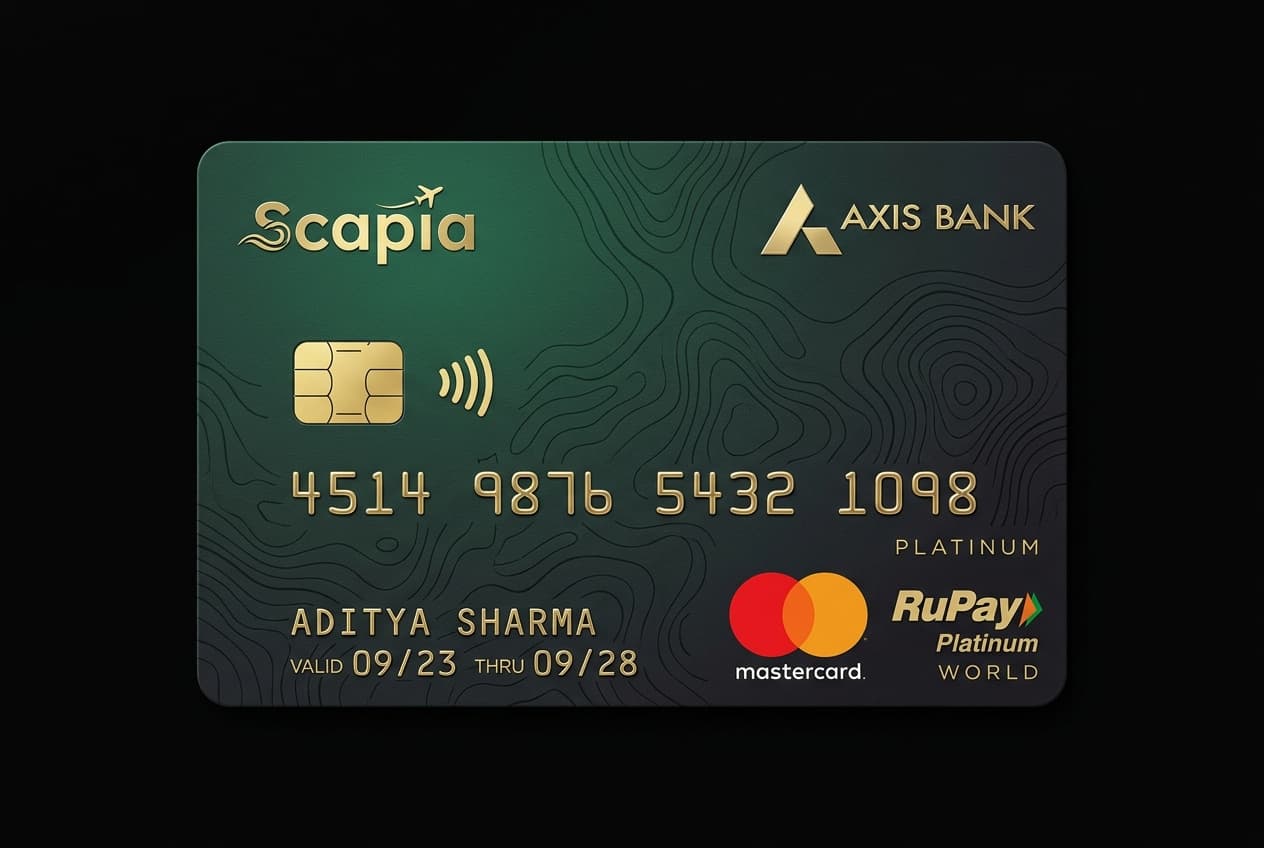
Best for: International Travelers, Zero Forex Seekers & Budget Flight/Hotel Bookers
No complimentary lounge access
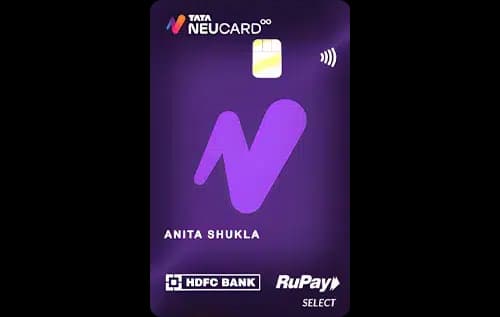
Best for: Frequent shoppers across the Tata consumer ecosystem and digital spenders wanting maximum rewards on QR code merchant UPI payments.
No complimentary lounge access
Renewal fee waived on ₹3,00,000 annual spend
Frequently Asked Questions
Verified answers to common applicant questions
Q1When do the new Google Pay Flex rewards start?
Q2How much does Google Pay Flex earn after October 16?
Q3Does 3.2% apply only to spending above ₹15,000?
Q4What happens if I didn't use Flex last month?
Q5What is one Google Star worth?
Q6Is there a monthly reward cap?
Q7Is Google Pay Flex Axis Bank Credit Card lifetime free?
Q8Is Google Pay Flex SBI Card lifetime free?
Q9Which is better: Flex Axis or Flex SBI?
Q10Is Flex better than Kiwi?
Q11Do Google Flex Stars expire?
CardRecommend bases all reward percentages, fee policies, and milestone thresholds on official issuer MITCs, schedule of charges, and RBI circulars.
.jpeg&w=1920&q=75&dpl=dpl_CkSdgyVCujRBKtrXGmTEedwxpUyv)
Founder & Editor, CardRecommend
Founder & Editor of CardRecommend. Dedicated to researching credit card reward structures, fee waivers, airport lounge policies, and calculating real user value across Indian financial products.
Recommended Research & Comparisons
Expand your card strategy with related category breakdowns.
News & Regulatory Updates
UPI MDR From October 15, 2026: What Changes, Who Pays and How It Compares With Credit Cards
Under the new framework taking effect October 15, 2026, specified merchant UPI transactions above ₹2,000 attract a 0.4% MDR capped at ₹300. Consumers remain free from charges, and RuPay on UPI sits under its own credit rules. Here is how the numbers, exemptions, and card economics compare.

Best Cards / Top Picks
Best RuPay Credit Cards for UPI Payments in India (2026): Ranked by Return
How to earn 1.5% to 10% cashback on daily merchant QR code scans without paying merchant convenience fees.
Best Cards / Top Picks
Best Credit Cards for Dining, Food Delivery & Groceries in India (2026)
From 10% on Swiggy and Zomato to accelerated returns on Blinkit, Zepto, DMart, and weekend restaurant dining.
Head-to-Head Comparison
Airtel Axis vs Axis ACE: Which Utility & Bill Payment Card Wins in 2026?
Comparing 25% Airtel & 10% BBPS utilities against 5% Google Pay bill payments and 1.5% unlimited offline swipes.