Executive Summary
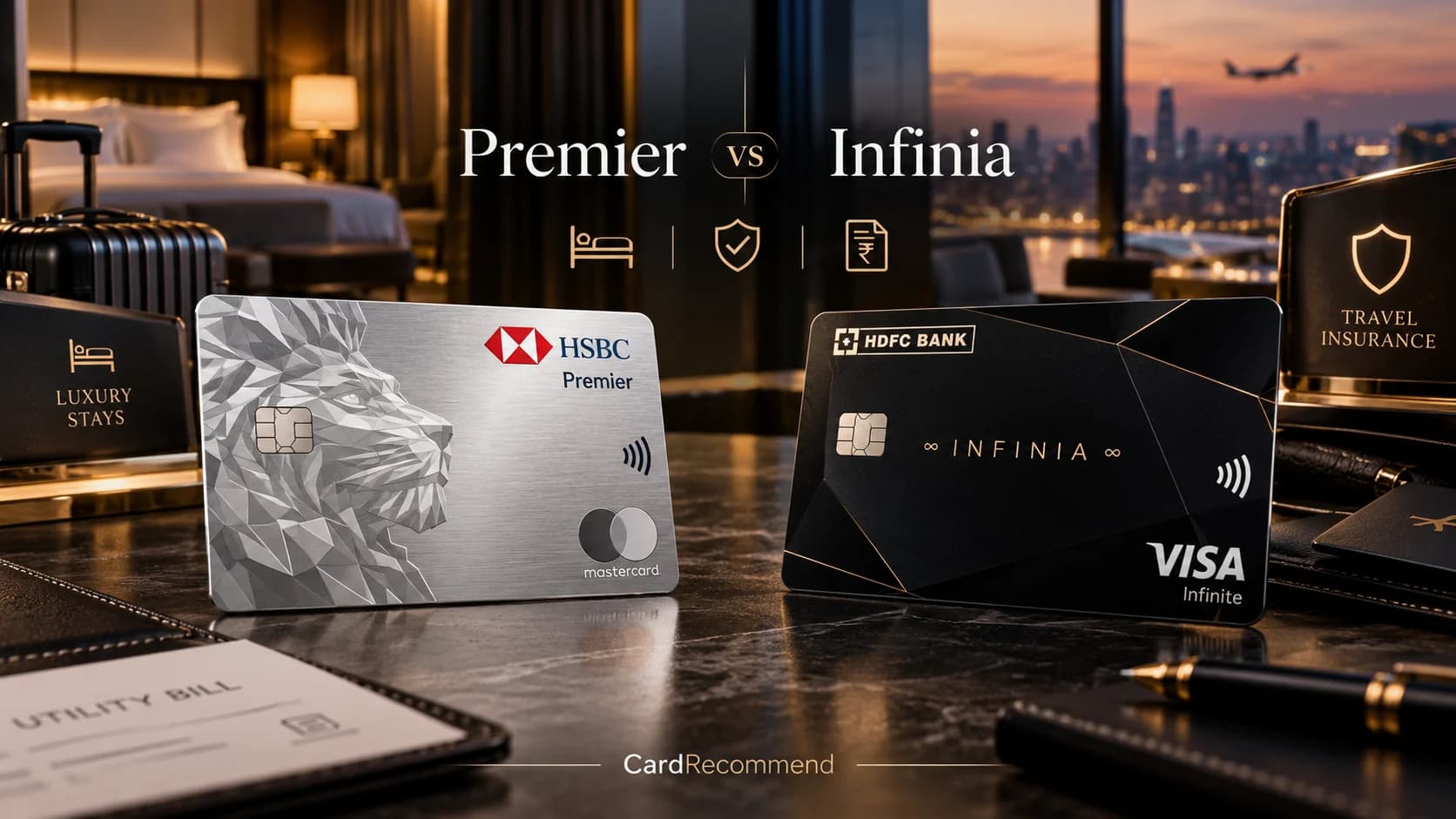
HDFC Infinia dominates SmartBuy and flexible travel, but HSBC Premier strikes back with 1:1 Accor transfers, tax payment rewards, and a 0.99% forex markup. We calculate the exact math on utilities, insurance, and hotel points.
Subject Cards
HSBC Premier Metal Credit Card
HSBC Premier Banking clients, global jet-setters, corporate executives, and international travelers wanting near-zero forex markups and bespoke hospitality perks.

HDFC Bank INFINIA Metal Credit Card
Ultra-high-net-worth individuals, luxury frequent flyers, and high spenders seeking the highest reward return on travel bookings in India.
In This Guide
HDFC Infinia has spent years being the default answer to a simple question:
Which premium Indian credit card should a high spender use?
HSBC Premier now makes that answer much less obvious.
Both are metal cards aimed at affluent customers. Both offer unlimited airport-lounge access, premium travel benefits and strong reward programmes.
But the cards behave very differently once you move beyond ordinary retail spending.
The difference becomes particularly important if a meaningful part of your annual expenditure goes toward:
- income tax or other government payments
- utilities
- large insurance premiums
- international spending
- hotel loyalty programmes such as Accor ALL
HDFC Infinia still has the stronger all-round domestic rewards engine, especially if you regularly extract ₹1 per Reward Point through SmartBuy and use its accelerated earning opportunities.
But HSBC Premier has a remarkable advantage where Infinia becomes weak:
Premier continues rewarding several categories that many premium cards either exclude or heavily restrict, up to a shared ₹1 lakh of eligible spending every month.
And for an Accor user, the difference becomes even larger.
HSBC Premier transfers:
1 HSBC Reward Point = 1 ALL Accor Reward Point
HDFC Infinia transfers:
2 HDFC Reward Points = 1 ALL Accor Reward Point
So this is no longer simply a comparison between 3 HSBC points per ₹100 and roughly 3.33 Infinia points per ₹100.
The redemption route can completely reverse the winner.
Terms verified: 24 October 2026
The Short Answer
If you want one premium card for ordinary spending, SmartBuy, flights, hotels and high-value domestic redemptions:
HDFC Infinia remains the stronger primary card.
If you regularly pay income tax, utilities and other categories where most premium cards become unrewarding—and you genuinely use Accor:
HSBC Premier can produce materially better value.
For insurance alone, the answer is more nuanced.
HSBC Premier rewards insurance only within its shared ₹1 lakh monthly special-category allowance.
Infinia allows much more insurance expenditure to earn rewards, with its current 10,000 Reward Point monthly insurance cap.
So the simplest version is:
Tax → HSBC Premier wins decisively
Utilities → HSBC Premier generally wins for Accor users
Large insurance premiums → Infinia can win
Accor transfers → HSBC Premier wins decisively
SmartBuy and mainstream premium-card usage → Infinia wins
And for a very high spender who already qualifies for both?
The strongest setup may not be choosing one.
It may be using Infinia as the primary rewards card and Premier as the specialist card for tax, selected restricted categories, Accor transfers and international spending.
HSBC Premier vs HDFC Infinia at a Glance
| Feature | HSBC Premier | HDFC Infinia Metal |
|---|---|---|
| Card type | Metal | Metal |
| Base earn | 3 RP / ₹100 | 5 RP / ₹150 |
| Approx. points per ₹100 | 3 | 3.33 |
| Accor transfer | 1:1 | 2:1 |
| Accor points from ₹1 lakh base spend | 3,000 | ~1,666 |
| Utility rewards | Yes, within shared ₹1 lakh monthly special-category spend limit | Yes, max 2,000 RP/month |
| Tax/government rewards | Yes, within shared ₹1 lakh monthly limit | No rewards on government-related transactions |
| Insurance rewards | Yes, within shared ₹1 lakh monthly limit | Yes, max 10,000 RP/month |
| Reward expiry | Never expires | Subject to HDFC reward validity rules |
| Forex markup | 0.99% | 2% |
| Lounge access | Unlimited domestic + international; 8 international guest visits | Unlimited domestic + international for primary/add-on cardholders |
| Joining fee | ₹12,000 | ₹12,500 + taxes |
| Renewal fee | ₹20,000, waived for qualified Premier relationship | ₹12,500 + taxes |
| Renewal waiver | Maintain qualifying HSBC Premier relationship | ₹10 lakh annual spend |
| Availability | Qualified HSBC Premier customers | Invitation only |
The headline base earning rates look similar.
The real difference is what those points can become.
Base Rewards: Infinia Wins by a Small Margin
HDFC Infinia earns:
5 Reward Points per ₹150
That works out to approximately:
3.33 Reward Points per ₹100
HSBC Premier earns:
3 Reward Points per ₹100
So at the point-earning level, Infinia has a small advantage.
On ₹1 lakh of ordinary eligible spending:
HSBC Premier
₹1,00,000 × 3 RP / ₹100 = 3,000 RP
HDFC Infinia
Approximately:
3,333 RP
If you use HDFC points through SmartBuy for eligible flights or hotels at ₹1 per point:
3,333 RP ≈ ₹3,333 of redemption value
That is straightforward, flexible value.
This is why Infinia remains such a difficult primary card to replace.
But if your goal is Accor, the comparison flips completely.
Accor Changes the Entire Equation
HSBC Premier currently transfers Reward Points to ALL – Accor Live Limitless at:
1 HSBC RP = 1 ALL point
HDFC Infinia converts at:
2 HDFC RP = 1 ALL point
Accor's own programme states that:
2,000 ALL Reward Points = €40
for eligible redemptions.
So consider the same ₹1 lakh of ordinary spending.
HSBC Premier
3,000 HSBC RP
→ 3,000 ALL points
HDFC Infinia
~3,333 HDFC RP
→ ~1,666 ALL points
HSBC therefore generates roughly 80% more Accor points from the same base spending.
That is not a small difference.
For someone who regularly stays at Accor properties, HSBC's slightly weaker base earn rate becomes irrelevant because the transfer ratio more than compensates for it.
₹1 Lakh General Spend: SmartBuy vs Accor
This illustrates why there is no universal winner.
With Infinia
₹1 lakh normal spend:
~3,333 Reward Points
Use through eligible SmartBuy flights/hotels:
up to ~₹3,333
Transfer to Accor:
~1,666 ALL points
With HSBC Premier
₹1 lakh normal spend:
3,000 Reward Points
Transfer to Accor:
3,000 ALL points
At Accor's fixed redemption structure, 3,000 ALL points represent €60 of eligible Accor value.
The question becomes:
Do you prefer HDFC's flexible ₹1-per-point SmartBuy value, or materially more Accor points?
For a frequent Accor guest, I would choose Premier.
For someone who books whichever airline or hotel is cheapest through SmartBuy, Infinia remains easier to maximise.
Tax Is Where HSBC Premier Destroys the Comparison
This is Premier's biggest structural advantage.
HSBC's current Reward Programme terms explicitly include tax-payment MCC 9311 among categories eligible to earn Reward Points within the special-category allowance.
That allowance is:
₹1,00,000 of cumulative spending per month
across the applicable restricted categories.
So if you make ₹1 lakh of qualifying tax payments in a month and have not consumed the shared allowance elsewhere:
₹1,00,000 → 3,000 HSBC Reward Points
Those can potentially become:
3,000 Accor points
or be transferred to another eligible HSBC airline/hotel partner at the applicable ratio.
HDFC Bank is completely different.
Its current terms state that government-related transactions do not earn Reward Points on Infinia.
So for a qualifying government/tax payment:
HSBC Premier
Potentially earns rewards within the ₹1 lakh shared monthly allowance.
HDFC Infinia
0 Reward Points
For an affluent cardholder paying significant personal taxes, this alone can justify keeping Premier as a specialist card.
But the HSBC ₹1 Lakh Limit Is Shared
This is critical.
Do not interpret Premier's rule as:
₹1 lakh utilities + ₹1 lakh tax + ₹1 lakh insurance
every month.
It is one ₹1 lakh cumulative spend allowance across categories including:
- utilities
- tax
- real estate/managers
- selected financial/non-financial institutions
- money transfer
- jewellery
- insurance
- e-wallets
- certain education/government transactions
- other listed special categories
So imagine one month contains:
₹50,000 utilities + ₹40,000 insurance + ₹60,000 tax
Total:
₹1,50,000
Only up to the applicable ₹1 lakh cumulative special-category spend limit earns HSBC Premier Reward Points.
That cap needs to be understood before calling Premier an unlimited tax-and-utility card.
Utilities: HSBC Premier Has the Higher Useful Ceiling
HDFC Infinia does earn Reward Points on utilities.
But current HDFC terms cap utility earnings at:
2,000 Reward Points per calendar month
At the base Infinia rate of 5 RP per ₹150, that cap is reached at roughly:
₹60,000 of eligible utility spending
assuming ordinary base earning.
HSBC Premier can reward up to:
₹1 lakh of cumulative special-category spending per month
So if utilities are the only special category you use that month:
₹1 lakh utilities on HSBC Premier
3,000 Reward Points
→ 3,000 ALL points if transferred to Accor.
₹1 lakh utilities on Infinia
Utility reward cap:
2,000 HDFC RP
Transfer to Accor:
1,000 ALL points
For an Accor user, that is a huge difference:
3,000 ALL vs 1,000 ALL
from the same ₹1 lakh utility bill.
But Infinia's Utility Points Can Still Be Worth ₹1 Each
There is an important counterargument.
You do not have to transfer Infinia points to Accor.
The 2,000 HDFC Reward Points earned from utilities can instead potentially be worth:
₹2,000
when used for eligible SmartBuy flights/hotels.
HSBC's 3,000 Accor points represent fixed Accor-hotel value rather than cash.
So if you do not use Accor, HSBC's theoretical transfer advantage is much less relevant.
That is the recurring theme in this comparison.
Premier's numbers look spectacular when you have the right transfer partner.
Infinia's rewards are easier to use broadly.
Insurance: Infinia Fights Back
Insurance is where the simplistic “Premier rewards excluded categories” argument breaks down.
HSBC Premier does reward insurance.
But insurance is part of the shared:
₹1 lakh monthly special-category allowance
Infinia separately allows insurance transactions to earn rewards up to:
10,000 Reward Points per month
At 5 RP per ₹150, that corresponds to roughly:
₹3 lakh of eligible insurance premiums per month
before the insurance-specific RP cap is reached.
That makes Infinia much more suitable for very large premiums.
₹1 Lakh Insurance Premium: Which Card Wins?
Let's assume a single eligible ₹1 lakh insurance payment.
HSBC Premier
₹1 lakh × 3 RP / ₹100
= 3,000 RP
Transfer to Accor:
3,000 ALL points
HDFC Infinia
₹1 lakh at 5 RP / ₹150
≈ 3,333 RP
Transfer to Accor:
≈ 1,666 ALL points
Or use through qualifying SmartBuy travel:
≈ ₹3,333
So:
Accor-focused → HSBC Premier wins
Flexible ₹1/RP SmartBuy value → Infinia wins
The answer depends on redemption, not simply the headline earn rate.
₹3 Lakh Insurance Premium: Infinia Becomes Much Stronger
Now consider a ₹3 lakh insurance premium.
Assume there are no other relevant capped transactions that month.
HSBC Premier
Only the first ₹1 lakh falls inside its shared special-category reward allowance.
Reward:
3,000 RP
HDFC Infinia
₹3 lakh at the ordinary earn rate reaches:
10,000 RP
which is also the current monthly insurance cap.
That can represent:
up to ₹10,000 of eligible SmartBuy flight/hotel redemption value
or:
5,000 ALL points
at the current 2:1 Accor transfer ratio.
For very large insurance payments, Infinia clearly becomes the better tool.
This is why CardRecommend would not simply say:
“Use HSBC Premier for insurance.”
The spend amount matters.
Insurance Spending vs Insurance Protection Are Different Questions
There is another meaning of “insurance” in a premium-card comparison: the complimentary insurance protection bundled with the card.
HDFC publishes unusually clear numbers for Infinia.
Current HDFC documentation lists:
- ₹3 crore air-accident cover
- up to ₹50 lakh overseas emergency medical cover
- up to ₹9 lakh credit-shield cover
- up to ₹9 lakh lost-card liability for the primary cardholder
Certain travel covers require the relevant ticket to have been purchased using Infinia.
HSBC Premier also includes international travel insurance covering areas such as lost baggage, delays and travel-document problems, plus up to ₹3 lakh of online fraud/lost-card misuse protection under its current public proposition.
But HSBC's current public Premier page does not publish directly comparable sum-insured numbers for every travel-insurance category.
So I would not claim that one card has universally “better insurance” without comparing the actual policies line by line.
HDFC is simply much more transparent about the large headline coverage amounts on its current public documentation.
HSBC Has Another Major Advantage: 0.99% Forex
For a premium traveller, this matters.
HSBC Premier:
0.99% foreign-currency markup
HDFC Infinia:
2%
On ₹5 lakh equivalent of overseas card spending:
Premier base forex markup
₹5,00,000 × 0.99%
= ₹4,950
Infinia base forex markup
₹5,00,000 × 2%
= ₹10,000
before applicable taxes and exchange-rate effects.
Difference:
₹5,050
before tax.
That is meaningful.
And Premier still earns its normal eligible reward structure while giving access to the 1:1 partner network.
For frequent international spenders, HSBC becomes increasingly compelling.
The HSBC Transfer Network Is Broader Than Just Accor
Accor is the easiest example because the value is transparent.
But Premier's current hotel-transfer table also includes:
- IHG One Rewards — 1:1
- Marriott Bonvoy — 1:1
- Wyndham Rewards — 1:1
- Shangri-La Circle — 5:1
There is also a substantial airline partner list, with many programmes at 1:1.
That makes HSBC points more like a transferable currency than a conventional bank reward point.
Premier Reward Points also currently do not expire.
That flexibility matters for someone accumulating points for premium-cabin flights or hotel redemptions rather than redeeming every month.
Infinia's Counterattack Is SmartBuy
This is where many comparisons of these two cards go wrong.
Looking only at base earning makes Premier look extremely competitive.
But Infinia's real advantage has never been merely 5 RP per ₹150.
It is SmartBuy.
HDFC currently advertises:
up to 10X Reward Points on SmartBuy spending
along with ₹1-per-point redemption for eligible flights and hotels.
That creates opportunities for reward rates Premier's ordinary 3 RP/₹100 cannot match.
If much of your spending can be intelligently routed through SmartBuy's eligible accelerated categories, Infinia can remain substantially more rewarding.
That is why I would not replace Infinia with Premier purely because Premier has 1:1 Accor.
HSBC Has Travel With Points — But It Is a Different Ecosystem
Premier is not limited to base rewards.
HSBC's Travel with Points platform currently offers up to:
12X Reward Points
on qualifying hotel, flight and car-rental bookings.
The programme uses Hopper infrastructure, and accelerated points are currently capped at:
18,000 accelerated Reward Points per calendar month
for the applicable cards.
That can materially improve Premier's travel earning.
But this is not the same ecosystem as SmartBuy.
Which portal produces better real-world value depends on:
- the actual fare/rate
- availability
- cancellation terms
- convenience fees
- the multiplier available
- how you plan to redeem the resulting points
A higher multiplier is worthless if the underlying booking costs significantly more.
Always compare final prices.
Reddit Users Have Arrived at the Same Two-Card Strategy
Current enthusiast discussion around Premier and Infinia has increasingly moved away from asking:
“Which one is better?”
and toward:
“Which spend should go on which card?”
Infinia holders commonly describe keeping it as their primary card for SmartBuy and normal eligible spending while moving taxes and other restricted categories to HSBC Premier.
Accor users also repeatedly point to Premier's 1:1 transfer ratio as its strongest differentiator.
At the same time, users who have tried both frequently prefer SmartBuy's breadth and established ecosystem over HSBC's Hopper-powered travel portal.
Those are personal experiences rather than product facts.
But they reflect the financial structure accurately:
Infinia is the broader primary-card engine.
Premier fills several of Infinia's most valuable gaps.
Fees: The Cards Target Affluence Differently
Infinia Metal costs:
₹12,500 + applicable taxes
for joining and renewal.
The renewal fee is waived after:
₹10 lakh of spending in the preceding 12 months.
It remains invitation only.
HSBC Premier works differently.
Joining fee:
₹12,000
Annual renewal fee:
₹20,000
but the annual fee is waived while the customer maintains a qualifying HSBC Premier relationship.
Current Premier eligibility can be met through criteria such as:
- ₹50 lakh quarterly Total Relationship Balance, or
- ₹3 lakh net monthly salary credit, or
- the qualifying mortgage route with the required relationship balance
So Premier's annual-fee economics are attractive only if HSBC Premier banking itself makes sense for you.
Do not move ₹50 lakh of assets solely to avoid a credit-card renewal fee.
The banking relationship should independently fit your finances.
Welcome Benefits Also Differ
Infinia currently offers:
12,500 Reward Points
after fee realisation and activation, along with first-year Club Marriott membership.
HSBC Premier currently advertises:
20,000 welcome Reward Points
after meeting the applicable introductory conditions.
For someone redeeming those Premier points into a 1:1 hotel programme, that can represent a meaningful first-year offset against the ₹12,000 joining fee.
But welcome bonuses are one-time.
They should not determine a long-term card decision.
Lounge Access Is Strong on Both
Both products are genuinely premium here.
HSBC Premier
- unlimited domestic airport lounge access
- unlimited international airport lounge access for cardholders
- 8 complimentary international guest visits
HDFC Infinia
- unlimited domestic and international airport lounge access
- benefit also extends to eligible add-on cardholders under current terms
I would not choose between the cards based purely on the primary cardholder's lounge access.
Both already solve that problem.
Which Card Wins on ₹1 Lakh of Different Spending?
This is the most useful comparison.
| ₹1 lakh eligible spend | HSBC Premier | HDFC Infinia |
|---|---|---|
| Normal retail | 3,000 RP | ~3,333 RP |
| Accor points from normal retail | 3,000 ALL | ~1,666 ALL |
| Utilities | 3,000 RP* | 2,000 RP cap |
| Accor points from utilities | 3,000 ALL* | 1,000 ALL |
| Tax/government | 3,000 RP* | 0 RP |
| Insurance | 3,000 RP* | ~3,333 RP |
| Accor points from insurance | 3,000 ALL* | ~1,666 ALL |
*Assumes that the HSBC Premier shared ₹1 lakh monthly special-category allowance has not already been consumed by other qualifying capped categories.
That footnote is essential.
Without it, Premier would look more generous than it actually is.
Which Card Wins for Utilities?
HSBC Premier, particularly for Accor users.
Infinia's 2,000-point monthly utility cap is reached at roughly ₹60,000 of ordinary utility spending.
Premier can reward as much as ₹1 lakh of utility spend if no other special-category expenditure consumes the shared allowance.
If you then convert to Accor, the transfer difference becomes enormous.
Which Card Wins for Tax?
HSBC Premier by a wide margin.
Premier explicitly rewards eligible tax payments within the shared ₹1 lakh monthly special-category allowance.
Infinia does not reward government-related transactions.
For someone paying meaningful personal taxes, this may be Premier's single best reason to exist alongside Infinia.
Which Card Wins for Insurance?
It depends on premium size.
Up to ₹1 lakh and Accor-focused → HSBC Premier
Large insurance premiums above ₹1 lakh → HDFC Infinia
Infinia's 10,000 RP monthly insurance cap gives it much more headroom.
Which Card Wins for Accor?
HSBC Premier, comfortably.
Premier:
1 RP = 1 ALL
Infinia:
2 RP = 1 ALL
Combined with the relatively similar base earn rates, Premier generates about 1.8 times as many Accor points from normal uncapped base spending.
If Accor is genuinely part of your hotel strategy, that is a major advantage.
Which Card Wins for Ordinary Everyday Spending?
HDFC Infinia.
The base point rate is slightly higher.
More importantly, Infinia's SmartBuy accelerated-rewards ecosystem and straightforward ₹1-per-point flight/hotel redemption remain exceptionally strong.
If you do not have a specific airline/hotel loyalty strategy, Infinia is easier to extract value from.
Which Card Wins for International Spending?
HSBC Premier.
The difference between:
0.99% forex
and:
2% forex
is meaningful at affluent-card spending levels.
Premier also offers strong transfer flexibility.
Should You Replace Infinia With HSBC Premier?
For most existing Infinia holders:
No.
If you already have Infinia, I would not close it simply because Premier offers better Accor transfers or tax rewards.
The two cards solve different problems.
The more logical strategy is:
Infinia → SmartBuy, mainstream retail and high-value flexible redemptions
Premier → tax, selected restricted categories, Accor/hotel transfers and international spending
That combination eliminates several weaknesses of each card.
What If You Can Hold Only One?
This is the harder question.
I would choose HDFC Infinia if:
- SmartBuy is central to your rewards strategy
- you value flexible ₹1-per-point flight/hotel redemption
- most spending is normal retail rather than tax/government
- you pay very large insurance premiums
- you want a premium card without restructuring your banking relationship
- you already have the invitation
I would choose HSBC Premier if:
- you already qualify naturally for HSBC Premier banking
- you pay significant tax and utility bills
- you use Accor, Marriott, IHG or other transfer partners
- international card spending is substantial
- you value evergreen points
- you prefer transferable rewards over portal-based ₹1-per-point redemptions
The cards are closer than their reputations suggest.
Compare HSBC Premier vs HDFC Infinia Head-to-Head
Evaluate reward rates across utilities, tax payments, 1:1 hotel transfers, SmartBuy multipliers, and calculate your real annual value in CardRecommend's comparator.
CardRecommend Verdict
HDFC Infinia remains the better all-round primary premium credit card, but HSBC Premier is now the better specialist card for several categories affluent users actually spend heavily on.
If I had to choose only one for a typical high-spending household, I would still pick Infinia.
Its roughly 3.33 Reward Points per ₹100 base earn, SmartBuy accelerators, ₹1-per-point eligible travel redemptions, high insurance-reward ceiling and established premium benefits make it easier to extract value without committing to a specific hotel programme.
But there are three areas where Premier is clearly superior.
First: tax.
Infinia gives you nothing on government-related payments.
Premier can earn 3 RP per ₹100 on eligible tax payments within its shared ₹1 lakh monthly special-category allowance.
Second: Accor.
Premier's 1:1 transfer means ₹1 lakh of base spending generates 3,000 ALL points.
Infinia generates roughly 1,666.
That is around 80% more Accor points from Premier.
Third: international spending.
A 0.99% forex markup is materially better than Infinia's 2%.
Where I would not automatically choose Premier is insurance.
For a ₹1 lakh premium, Premier can be excellent—especially if you want Accor.
For a ₹3 lakh premium, Infinia's 10,000-point monthly insurance cap gives it much more room to earn.
So the best affluent-card strategy in late 2026 is not necessarily:
HSBC Premier or HDFC Infinia.
It can be:
HDFC Infinia + HSBC Premier.
Use Infinia where SmartBuy and its ₹1-per-point ecosystem dominate.
Use Premier where HDFC stops rewarding you—and transfer those points into hotel and airline programmes where 1:1 actually matters.
If you already qualify naturally for HSBC Premier, that combination is one of the strongest premium two-card setups available today.
Cards Compared in This Article

Frequently Asked Questions
Is HSBC Premier better than HDFC Infinia?
Not overall.
HDFC Infinia remains stronger as a general-purpose premium rewards card because of SmartBuy and flexible ₹1-per-point travel redemption.
HSBC Premier is stronger for tax, selected restricted categories, hotel transfers and forex spending.
Does HSBC Premier earn Reward Points on income-tax payments?
Current HSBC Premier reward terms include tax payments under the categories that can earn Reward Points within a shared ₹1 lakh cumulative monthly special-category spend limit.
Does HDFC Infinia earn Reward Points on tax payments?
HDFC's current terms say government-related transactions do not earn Reward Points on Infinia.
Does HSBC Premier earn rewards on utilities?
Yes, within the shared ₹1 lakh monthly special-category spend allowance.
How many Reward Points can Infinia earn on utilities?
Utility Reward Points are currently capped at:
2,000 RP per calendar month
which corresponds to roughly ₹60,000 of utility spending at the standard 5 RP per ₹150 rate.
Which card is better for insurance premiums?
For smaller premiums and Accor-focused redemption, HSBC Premier can be better.
For large insurance payments, Infinia has much more headroom because its current insurance cap is:
10,000 RP per month
equivalent to roughly ₹3 lakh of base-rate insurance spending.
What is HSBC Premier's Accor transfer ratio?
1 HSBC Reward Point = 1 ALL Accor Reward Point.
What is HDFC Infinia's Accor transfer ratio?
2 HDFC Reward Points = 1 ALL Accor Reward Point.
What is an ALL Accor Reward Point worth?
Accor's programme currently uses:
2,000 ALL Reward Points = €40
for eligible hotel redemption.
Do HSBC Premier Reward Points expire?
No.
HSBC currently states that Premier Reward Points do not expire.
Which card has lower forex markup?
HSBC Premier:
0.99%
HDFC Infinia:
2%
Which card is cheaper?
Infinia charges ₹12,500 plus taxes annually, with a waiver after ₹10 lakh of eligible annual spending.
HSBC Premier charges a ₹12,000 joining fee and ₹20,000 annual renewal fee, but the renewal fee is waived for customers who continue to qualify for HSBC Premier.
Can anyone apply for HDFC Infinia?
No.
Infinia Metal remains invitation only.
Can anyone apply for HSBC Premier?
No.
The credit card is available to qualified HSBC Premier banking customers who meet the applicable relationship criteria.

Founder & Editor, CardRecommend
Founder & Editor of CardRecommend. Dedicated to researching credit card reward structures, fee waivers, airport lounge policies, and calculating real user value across Indian financial products.